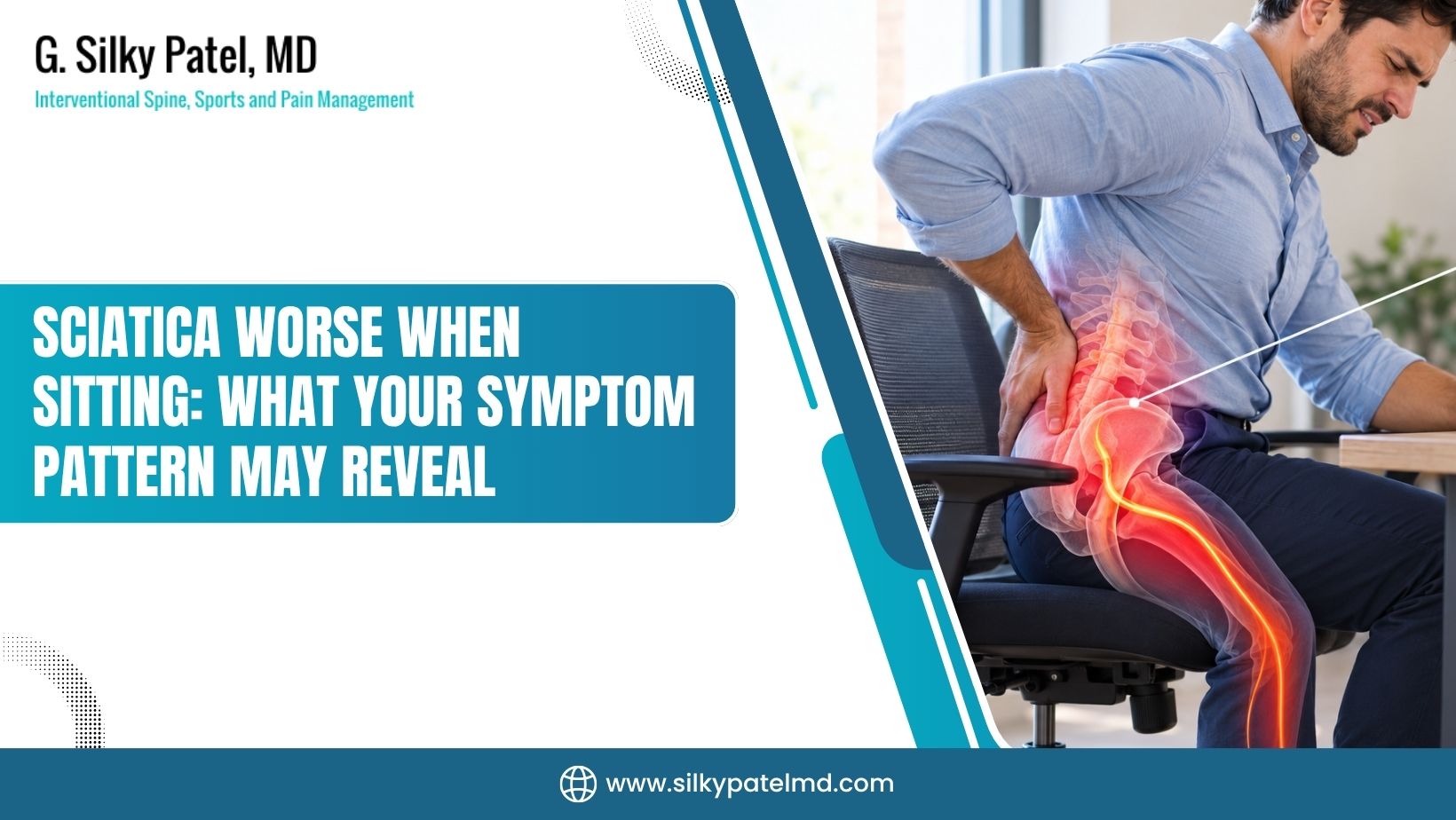
Sciatica worse when sitting can make an ordinary commute, workday, or evening on the couch feel surprisingly difficult, especially when pain travels from the low back or buttock into the leg. The timing of your symptoms matters, but sitting alone cannot identify the exact cause.
This guide explains what your symptom pattern may reveal, how to track pain by location and duration, which sitting adjustments may reduce irritation, and when persistent or urgent symptoms should be evaluated.
If you are looking for a sciatica doctor near me in Houston, Dr. Silky Patel can help assess whether the symptoms fit a nerve-related condition and discuss appropriate next steps based on an individualized evaluation.
Sciatica Worse When Sitting: What the Pattern May Reveal
Sitting changes the position of the low back, pelvis, hips, and nearby nerve structures. For some people, staying seated increases pressure or tension around an irritated nerve.
For others, sitting is not the main trigger; the real issue may be the transition from sitting to standing, a slouched position, prolonged driving, or a separate hip or spinal problem.
A useful symptom pattern is not simply, “It hurts when I sit.” The more helpful questions are: How long does it take for symptoms to start?
Where do they travel? Do they stop when you stand, or do they continue? Does changing position help? These details give Dr. Patel a clearer starting point for evaluation.
Track When Symptoms Begin
When discussing sciatica worse when sitting, write down how long you can sit before symptoms appear. You may notice pain immediately, after 10 minutes, or only after a longer period. Also record whether symptoms build gradually or begin suddenly after a particular movement.
For example, pain that appears after a long car ride may reflect sustained hip and low-back positioning. Symptoms that begin quickly in a soft chair may be related to slumped posture or reduced support. Neither pattern confirms a diagnosis, but both help identify useful questions for an evaluation.
Track what happens after you stand. If the pain eases within a few minutes, note that. If numbness, tingling, or leg weakness continues despite changing position, that is more important than the sitting duration alone.
Record Where Pain Travels
With sciatica worse when sitting, sciatica-type symptoms can include pain, burning, tingling, numbness, or weakness that extends from the low back or buttock into the thigh, calf, or foot. The path can differ depending on which nerve structures are irritated.
Use a simple body outline or written description to record the route. Note whether symptoms remain above the knee or continue below it. Also record whether the sensation stays on one side or affects both legs.
Pain location can change over time, so tracking it over several days may reveal a pattern that is difficult to recall during an appointment.
Notice the Difference Between Pain and Nerve Symptoms
While tracking sciatica worse when sitting, a deep ache in the low back or buttock is not the same as pins-and-needles, reduced sensation, or weakness in the leg. Sitting can aggravate more than one structure, including the lumbar spine, muscles around the hip, or the sacroiliac region.
If you’re dealing with sciatica worse when sitting, pay attention to practical changes, such as trouble lifting the front of the foot, difficulty climbing stairs, or the leg giving way. These findings deserve more attention than pain intensity alone.
Posture can influence symptoms, but it cannot establish whether the cause is disc-related irritation, narrowing around a nerve, facet arthrosis, sacroiliac joint pain, or another condition that Dr. Patel may evaluate.

Our personalized treatment plans are designed to help you feel better and live better.
Does Sitting Make Sciatica Worse for Everyone?
No. Sitting may worsen symptoms for some people, but the effect varies with the underlying problem, sitting position, activity level, and duration.
A person may feel better sitting with firm support but worse when leaning forward. Another person may tolerate sitting briefly but develop symptoms after remaining still for an extended period.
If you notice sciatica worse when sitting, this is why broad advice such as “never sit” is usually not practical or necessary. The goal is to identify positions and routines that reduce aggravation while keeping you safely mobile.
Why Slouching and Prolonged Sitting Can Matter
When you slump, the pelvis may roll backward and the low back may lose its natural support.
Depending on the individual, this position can increase discomfort in the low back and may increase sensitivity around already irritated nerve structures. Remaining still also reduces the frequent, small movements that normally change pressure across the spine and hips.
To understand sciatica worse when sitting, driving can be especially challenging because the seat, pedals, and steering wheel limit movement.
A wallet, phone, or other object in a back pocket may also tilt the pelvis and create an uneven sitting position. These details are easy to overlook when trying to understand why symptoms are worse after travel.
When Sitting Is Not the Main Cause
When evaluating sciatica worse when sitting, pain that increases with standing or walking but improves with sitting may point to a different mechanical response than pain that consistently increases while seated. Symptoms may also change with coughing, sneezing, bending, lifting, or getting out of bed.
The pattern is useful, but it is not a diagnosis. Similar symptoms can come from several spinal or nerve-related conditions, and hip or sacroiliac problems can sometimes feel similar.
Imaging may or may not be appropriate, depending on the history and examination. Dr. Patel can determine what information is needed rather than assuming that posture alone explains the problem.
Why a Symptom Diary Helps
For concerns about sciatica worse when sitting, a short diary can prevent an appointment from becoming a general description of “back pain.” Record the activity, sitting surface, duration, posture, symptoms, and what changed them. Include sleep position, exercise, lifting, and driving if those activities affect your day.
A practical entry might read: “After 25 minutes in a soft office chair, burning began in the right buttock and traveled to the calf.
Standing helped somewhat after five minutes, but tingling remained.” This level of detail helps Dr. Patel connect symptoms with function and decide whether further evaluation is warranted.
Our personalized treatment plans are designed to help you feel better and live better.
What Is the Best Sitting Position for Sciatica?
For people with sciatica worse when sitting, the best sitting position for sciatica is usually the one that keeps your spine and hips supported without forcing you into a rigid posture.
There is no single position that works for every person or every cause of leg pain. Use comfort and symptom response as guides, and change positions before discomfort has had time to build.
Adjust the Chair Before Adjusting Your Body
With sciatica worse when sitting, choose a chair that supports your pelvis and allows your feet to rest flat on the floor.
Your knees should be roughly level with, or slightly lower than, your hips if that position feels comfortable. A small cushion or lumbar support may help maintain a more neutral low-back position, but thicker support is not automatically better.
Avoid sitting at the very edge of the chair for long periods. That position can reduce back support and encourage forward leaning.
At the same time, do not force your back into an exaggerated arch if that increases symptoms. The right adjustment is the one that reduces irritation without creating a new pressure point.
Use Movement Breaks Instead of Waiting for a Flare
For people with sciatica worse when sitting, a movement break does not need to be a workout. Stand, walk a short distance, gently change position, or perform movements already recommended for you. The purpose is to avoid remaining in one position long enough for symptoms to intensify.
For desk work, consider a brief position change at regular intervals rather than waiting until pain is severe. Alternate between sitting and standing when possible.
During driving, plan safe stops on longer trips so you can get out and move. Do not stretch while operating a vehicle or when balance is uncertain.
Make Driving More Tolerable
For concerns about sciatica worse when sitting, move the seat close enough that you do not have to reach for the pedals.
Keep your hips supported and avoid twisting to enter or exit the vehicle. A small rolled towel may provide useful support, but remove it if it increases pressure or changes your symptoms.
When sciatica worse when sitting affects car rides, turn your whole body toward the door before standing rather than twisting sharply through the low back. This simple technique may reduce strain during a movement that often catches people off guard.
Avoid Common Sitting Mistakes
Several adjustments can backfire when applied too aggressively. Do not force a painful stretch, remain in a position because it is supposed to be “ideal,” or use a brace continuously without discussing whether it is appropriate.
Avoid sitting on a very soft surface if your pelvis sinks and your symptoms consistently worsen.
If you have sciatica worse when sitting and a position causes increasing numbness, new weakness, or pain that does not settle after changing position, stop using that adjustment. Practical changes should make daily activity more manageable, not conceal a worsening neurological problem.

Connect with our team to discuss your concerns, learn about our treatments, and find out how to get started as a new patient.
When Should You Seek Evaluation for Sciatica?
If you notice sciatica worse when sitting, consider an evaluation when symptoms persist, repeatedly return, interfere with sleep or work, or limit walking, driving, exercise, or routine tasks.
You do not need to wait until pain becomes unbearable. Earlier assessment can help clarify whether symptoms are likely coming from the spine, a nerve, the hip, the sacroiliac joint, or another source.
If you are searching for sciatica treatment near me or sciatica treatment specialist in Houston, focus on finding an evaluation that begins with your history and physical examination. Treatment decisions should follow the suspected source of symptoms rather than a generic list of procedures.
What an Evaluation May Consider
If you’re dealing with sciatica worse when sitting, Dr. Patel may ask when symptoms began, whether there was an injury, which positions increase or decrease pain, and whether numbness or weakness has changed. The evaluation may also consider walking, strength, sensation, reflexes, hip motion, and spinal movement.
While tracking sciatica worse when sitting, depending on the findings, care may involve activity guidance, targeted rehabilitation, medication discussions, diagnostic testing, or an interventional option when appropriate.
The purpose is to match the next step to the clinical picture. A scan can show structural changes that are not causing symptoms, so imaging findings should be interpreted alongside your symptoms and examination.
Warning Signs That Need Prompt Attention
Seek urgent medical attention for new loss of bladder or bowel control, inability to urinate, numbness in the saddle area, or rapidly worsening weakness in one or both legs.
These symptoms can indicate significant nerve involvement and should not be managed by changing a chair or waiting for a routine appointment.
When evaluating sciatica worse when sitting, prompt evaluation is also important for severe pain after significant trauma, fever with severe back pain, or symptoms accompanied by a serious underlying medical concern.
If you are unsure whether symptoms are urgent, contact emergency services or an appropriate urgent medical resource for immediate guidance.
What to Bring to an Appointment
To understand sciatica worse when sitting, bring a current list of medications and a concise symptom timeline. Include the positions that worsen or relieve symptoms, the distance pain travels, changes in sensation, and any functional problems such as weakness or difficulty walking.
If you have tried a cushion, standing desk, stretching routine, or over-the-counter medicine, record what happened. This information helps Dr. Patel distinguish a short-term comfort measure from an approach that may be aggravating symptoms or delaying needed assessment.
Building a Practical Plan for Sitting With Sciatica
If you notice sciatica worse when sitting, managing sitting-related symptoms is usually a process of testing small changes, observing the response, and adjusting the plan.
The goal is not to avoid every activity or find one perfect posture. The goal is to protect function while identifying what your symptoms are communicating.
Start With a Three-Part Routine
For people with sciatica worse when sitting, first, set up your chair so your feet are supported, your pelvis is stable, and your back is not forced into a painful angle.
Second, change position before symptoms become intense. Third, record whether the change actually helped after several minutes rather than judging it immediately.
If you work at a computer, place the screen at a height that does not require constant forward bending. Keep frequently used items close enough to avoid repeated twisting. If your job requires prolonged sitting, discuss reasonable position changes and task adjustments with the appropriate workplace contact.
Balance Activity With Irritability
To understand sciatica worse when sitting, complete bed rest can lead to stiffness and loss of conditioning, while pushing through escalating leg symptoms can make it harder to judge what is helping.
Gentle activity that does not increase neurological symptoms may be more practical than either extreme, but the appropriate level depends on your condition.
A useful rule is to notice the response later that day and the following morning. If a change produces progressively more leg pain, numbness, or weakness, it may not be suitable for you. If symptoms remain stable or improve, continue cautiously while following individualized guidance from Dr. Patel.
Know What Treatment Can and Cannot Be Decided From Sitting Symptoms
When evaluating sciatica worse when sitting, sitting-related pain can help describe a problem, but it cannot determine whether an injection, therapy, medication strategy, or another option is appropriate. Treatments are selected after considering the suspected pain generator, symptom duration, examination findings, medical history, and goals.
Some people improve with conservative care and gradual return to activity. Others may need additional evaluation when symptoms persist or function declines. The right plan may change as symptoms evolve. A treatment discussion should include expected purpose, alternatives, potential risks, and what follow-up would look like.
Take the Next Step With Better Information
When evaluating sciatica worse when sitting, before searching for the best sitting position for sciatica or comparing online treatment lists, spend a few days tracking the pattern if symptoms are mild and stable.
Note sitting duration, position, pain route, numbness, weakness, and response to movement. That record can make your next conversation more precise.
If symptoms continue, interfere with daily life, or include neurological changes, schedule an evaluation rather than relying only on posture modifications. Dr. Silky Patel provides pain medicine, spine care, and musculoskeletal evaluation in Houston, with recommendations based on the individual presentation.
A Note from Dr. Silky Patel
Sciatica worse when sitting is a meaningful symptom pattern, but it is only one part of the clinical picture. The most useful information includes when symptoms start, how far they travel, whether numbness or weakness is present, and what happens when you stand or change position.
Simple adjustments such as better support, regular movement breaks, and safer driving habits may reduce aggravation for some people. They should not replace an evaluation when symptoms persist, recur frequently, or affect strength and function. Urgent warning signs require prompt medical attention.
My goal is to help you understand what your symptoms may mean and choose the next step thoughtfully. If sitting-related leg pain continues, bring a clear symptom record to an evaluation so we can discuss whether further testing, conservative care, or another individualized option makes sense for you.