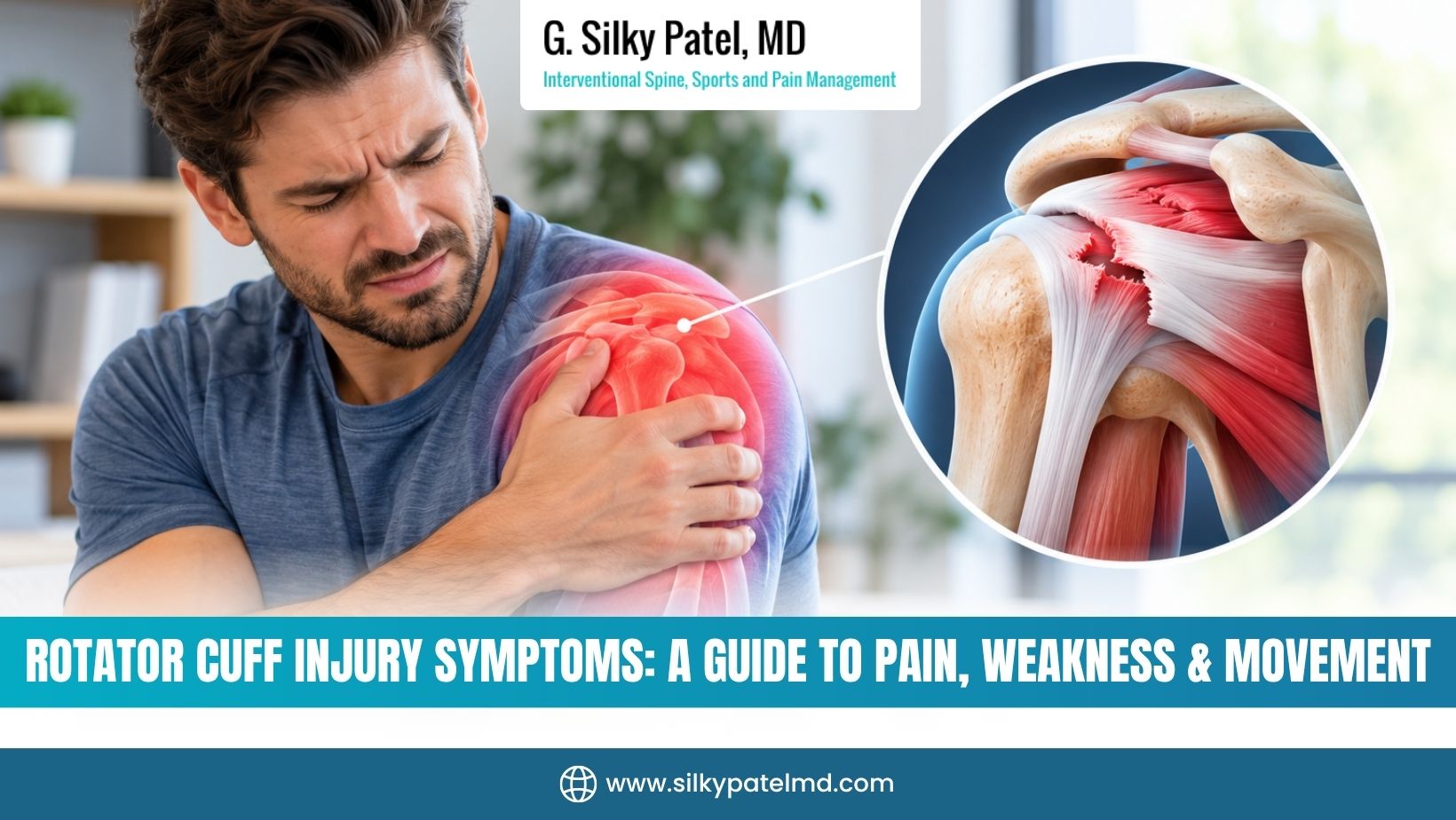
Rotator cuff injury symptoms can make ordinary movements—reaching overhead, putting on a shirt, lifting a grocery bag, or turning in bed—surprisingly difficult. The discomfort may feel mild at first, but pain, weakness, and reduced shoulder motion can interfere with work, exercise, and sleep.
Understanding the pattern of symptoms can help you decide when to monitor the problem and when to seek an evaluation.
This guide explains how rotator cuff problems may affect daily activities, why pain-limited movement is different from true weakness, what Dr. Silky Patel may assess, when imaging may be considered, and which treatment discussions may be appropriate.
Rotator Cuff Injury Symptoms: What They May Feel Like
Rotator cuff injury symptoms can vary depending on the affected tendon, the nature of the injury, and whether symptoms developed gradually or followed a specific event.
The rotator cuff is a group of tendons and muscles that helps stabilize the shoulder and guide arm movement. Symptoms alone cannot confirm whether a tendon is irritated, strained, partially torn, or completely torn, so an evaluation matters when pain or weakness persists.
Common Pain Patterns
In an evaluation of rotator cuff injury symptoms, many people describe pain on the outer or upper part of the shoulder.
The discomfort may spread down the upper arm but usually does not travel all the way into the hand. Pain may be sharper when the arm moves through certain positions and more of an ache when the shoulder is still.
For persistent rotator cuff injury symptoms, rotator cuff tear symptoms may include pain with reaching across the body, reaching behind the back, or raising the arm away from the side.
Some people notice a catching sensation, while others feel soreness without any obvious mechanical symptom. These descriptions are useful during an evaluation, but they do not identify the exact structure causing the pain by themselves.
Why Symptoms Can Be Worse at Night
Shoulder pain at night is common with several shoulder conditions, including rotator cuff-related problems. Sleeping on the affected side can place pressure on sensitive tissues. Sleeping on the opposite side may also cause discomfort if the painful arm falls forward or hangs without support.
If you have rotator cuff injury symptoms, a practical adjustment may be to sleep on your back with the affected arm supported by a pillow, or to place a pillow in front of your body when lying on the opposite side.
These steps may improve comfort, but persistent nighttime pain should not be dismissed simply because it occurs during sleep.
Pain Does Not Always Equal the Amount of Tissue Injury
The intensity of pain does not reliably show how extensive a tendon problem is. A relatively minor injury can be very painful, while a more significant tendon problem may cause less pain but more noticeable loss of strength. This is one reason self-diagnosis based on pain severity can be misleading.
For patients with rotator cuff injury symptoms, keep track of what triggers symptoms, whether the problem is getting better or worse, and whether you can still perform routine tasks. That information can help Dr. Patel connect your symptoms with the examination findings.

Our personalized treatment plans are designed to help you feel better and live better.
How Rotator Cuff Problems Affect Everyday Activities
Shoulder symptoms often become most obvious during specific tasks rather than while sitting still. The activity that exposes the problem can provide useful information about movement tolerance, but it does not establish a diagnosis.
Avoiding every shoulder movement can also lead to stiffness, so the goal is usually to modify aggravating activities while arranging appropriate guidance.
Reaching Overhead or Behind Your Back
Shoulder pain when lifting the arm may occur while placing an item on a shelf, washing your hair, reaching into a cabinet, or putting on a coat.
Some people can raise the arm partway but feel pain in a particular range. Others may feel that the arm is difficult to control as it comes down.
For patients with rotator cuff injury symptoms, reaching behind the back can be difficult when fastening clothing, tucking in a shirt, or reaching for a back pocket.
This movement combines shoulder rotation and extension, which may be uncomfortable when the shoulder is irritated. Do not repeatedly force the motion to test the joint; repeated painful testing can increase irritation without answering what is causing it.
Dressing, Grooming, and Household Tasks
If you have rotator cuff injury symptoms, a shoulder problem may make it difficult to put on a pullover shirt, insert an arm into a jacket sleeve, brush your hair, or wash the opposite shoulder.
Lifting a pan, carrying a bag, opening a heavy door, or placing luggage overhead may also reveal a difference between the affected and unaffected sides.
When assessing rotator cuff injury symptoms, temporary activity changes can reduce strain. You might keep frequently used items at waist or chest height, use the less painful arm for heavier objects, and avoid lifting with the arm held far away from the body.
These modifications are not a substitute for evaluation if weakness or pain continues.
Work, Exercise, and Driving
Desk work may be manageable, while tasks that require sustained reaching, pushing, pulling, or overhead activity are more difficult. Exercise movements such as presses, pull-downs, throwing, swimming, or repetitive lifting may aggravate symptoms.
Continuing through sharp pain in an effort to maintain a routine can make it harder to judge whether the shoulder is improving.
In an evaluation of rotator cuff injury symptoms, driving may be uncomfortable when turning the wheel, fastening a seat belt, or checking blind spots.
If pain limits your ability to control the vehicle safely, avoid driving until you can move comfortably and respond appropriately. Work restrictions, exercise progression, and return to activity should be based on the evaluation and the demands of your normal routine.
Our personalized treatment plans are designed to help you feel better and live better.
Pain-Limited Movement Versus Noticeable Weakness
One of the most important distinctions in shoulder evaluation is whether movement is limited mainly because it hurts or because the arm cannot produce normal force.
These experiences can overlap, and many people use the word “weak” to describe pain that makes movement feel difficult. Careful testing helps separate the two patterns.
What Pain-Limited Movement May Look Like
With rotator cuff injury symptoms that limit movement, you may be physically able to move the arm farther, but discomfort causes you to stop or protect the shoulder.
For example, you may raise the arm slowly but stop when pain increases, or you may move farther when the arm is supported than when you lift it independently.
With rotator cuff injury symptoms, pain-limited motion can occur with irritation in or around the shoulder and does not automatically mean there is a tear.
It can still be significant, especially when it affects dressing, sleep, work, or exercise. The degree of pain, the range of motion, and how symptoms respond to specific movements all matter.
What Noticeable Weakness May Look Like
Weakness is more concerning when the shoulder cannot generate or maintain force even when pain is not the main limiting factor. Examples may include difficulty lifting a light object that was previously easy, inability to keep the arm raised, or a clear difference between sides during a controlled movement.
With rotator cuff injury symptoms, sudden weakness after a fall, forceful pull, dislocation, or lifting event deserves timely medical attention.
It may reflect a substantial injury, although only an examination and, when appropriate, imaging can clarify the cause. Do not try to confirm a tear by repeatedly lifting heavy objects or performing forceful shoulder tests at home.
Why You Should Not Diagnose a Tear Yourself
Rotator cuff tear symptoms can resemble symptoms from bursitis, arthritis, tendon irritation, a stiff shoulder, or pain referred from the neck. A clicking or popping sound also does not prove that a tendon is torn. Conversely, the absence of a dramatic sound does not rule out a meaningful injury.
When tracking rotator cuff injury symptoms, the safest conclusion to draw from symptoms is whether the shoulder is interfering with function or showing a concerning change.
If pain persists, weakness is noticeable, or an injury caused an immediate loss of motion, schedule an assessment with Dr. Patel or seek appropriate urgent care based on the severity.

Connect with our team to discuss your concerns, learn about our treatments, and find out how to get started as a new patient.
How Dr. Patel Evaluates Shoulder Pain
A shoulder evaluation is designed to identify the most likely pain source, understand how the problem affects function, and determine whether additional testing is useful.
Dr. Silky Patel may consider the symptom pattern, the timing of onset, the physical examination, and other possible sources of shoulder or arm pain rather than relying on one symptom alone.
What to Expect During the History
While discussing rotator cuff injury symptoms, Dr. Patel may ask when the pain began, whether it followed an injury, and which movements reproduce it. Details about sleep, work, exercise, dressing, lifting, and reaching can be more informative than a general statement that the shoulder hurts.
It helps to describe whether symptoms are constant or intermittent, whether there is numbness or tingling, and whether weakness appeared suddenly or gradually. Bring a list of medications and relevant health information, and note any treatments or activity changes that have already been tried.
What the Physical Examination May Assess
The examination may include observation of posture and shoulder movement, comparison of both sides, and assessment of active and assisted range of motion. Dr. Patel may also evaluate strength in different positions, tenderness, pain with rotation, and how the shoulder and neck contribute to the symptoms.
To understand rotator cuff injury symptoms, this type of examination helps distinguish movement that stops because of pain from movement that is limited by weakness or stiffness. It also helps identify whether the symptoms fit a shoulder-related pattern or whether another area may need consideration.
When Imaging Might Be Considered
Imaging is not automatically necessary for every episode of shoulder pain. Dr. Patel may consider it when symptoms follow significant trauma, weakness is substantial or persistent, progress is limited despite appropriate care, or the examination raises concern about a structural problem.
Different imaging studies answer different questions. An X-ray may help assess bones and joint changes, while ultrasound or magnetic resonance imaging may provide information about tendons and other soft tissues. The appropriate study depends on the examination, symptom duration, injury details, and the clinical question being asked.
When evaluating rotator cuff injury symptoms, imaging findings also need to be interpreted alongside symptoms. Tendon changes can appear in people without major pain, so a scan should not be treated as a diagnosis in isolation. The most useful plan connects the imaging, examination, and your actual functional limitations.
When to Seek Care and What Treatment Discussions May Include
Many shoulder problems can be evaluated in an outpatient setting, but the timing of care matters.
An injury that causes immediate weakness or a major change in shoulder function should be addressed sooner than mild soreness that is steadily improving. The appropriate next step depends on the event, symptom severity, and examination findings.
After a Fall, Pull, or Lifting Injury
When evaluating rotator cuff injury symptoms, seek prompt medical evaluation after an injury if you cannot raise the arm, notice marked weakness, see an obvious deformity, or have severe pain that does not settle.
Numbness, unusual coolness or discoloration of the arm, or rapidly increasing swelling also warrants urgent attention. If there is chest pressure, shortness of breath, or symptoms that may not be coming from the shoulder, seek emergency care.
For patients with rotator cuff injury symptoms after a less severe injury, avoid the activity that caused the pain and use comfortable, gentle movement rather than repeatedly testing strength.
Ice or heat may provide temporary comfort for some people, but neither determines whether a tendon injury is present. Medication decisions should account for your health history and other medicines.
If Symptoms Develop Gradually
Gradual shoulder pain still deserves evaluation when it continues, disrupts sleep, limits normal activities, or begins to affect strength. Waiting indefinitely can lead to more activity avoidance and stiffness, while repeatedly pushing through pain can keep the shoulder irritated.
When tracking rotator cuff injury symptoms, a useful starting point is to identify the specific tasks you cannot perform comfortably.
Instead of saying only that the shoulder hurts, note whether you can dress, reach a shelf, lift a light object, sleep on either side, and move the arm through its usual range. This gives Dr. Patel practical information for planning the evaluation.
Treatment Options Depend on the Findings
Care may involve activity modification, targeted rehabilitation, medication considerations, or other approaches based on the suspected pain source and your goals. Treatment is individualized; an approach that is reasonable for gradually developing shoulder pain may not be appropriate immediately after a significant injury with sudden weakness.
When assessing rotator cuff injury symptoms, shoulder injections for pain may be discussed in selected situations, but an injection is not a way to confirm a rotator cuff tear and is not appropriate for everyone.
Dr. Patel may review the potential purpose, expected limitations, risks, alternatives, and how an injection fits into a broader care plan. The decision should follow an evaluation rather than be based on the presence of pain alone.
If rotator cuff injury symptoms suggest a more complex injury or do not improve as expected, follow-up helps reassess function and adjust the plan.
The goal is not simply to reduce pain temporarily; it is to understand what is limiting the shoulder and choose a safe, individualized next step.
A Note from Dr. Silky Patel
Shoulder pain becomes easier to navigate when you pay attention to function, not just intensity. Notice whether the problem is pain that stops movement, weakness that prevents movement, stiffness that restricts motion, or a combination of these symptoms.
Also note whether the change began after an injury and whether it is affecting sleep, dressing, reaching, lifting, work, or exercise.
Rotator cuff injury symptoms can overlap with several other shoulder conditions, so online information cannot determine whether a tear is present. If pain persists, weakness is noticeable, or an injury caused an immediate loss of function, an in-person evaluation can help clarify the next step.
At Dr. Silky Patel, we use your history, examination, and imaging when appropriate to guide individualized shoulder pain care. I encourage you to seek timely guidance rather than repeatedly testing the shoulder or trying to diagnose the cause on your own.