Diclofenac gel may offer localized relief for certain types of joint pain, especially when you want to avoid taking an oral anti-inflammatory medicine.
The important question is not simply whether the gel works, but whether the painful joint, your symptoms, and your medical history make a topical NSAID a reasonable option.
Joint pain can come from osteoarthritis, an injury, tendon or ligament irritation, bursitis, gout, inflammatory arthritis, or another condition that needs a different approach.
This guide explains how topical diclofenac works, where it may help, how to use it safely, and when persistent or worsening pain should be evaluated by Dr. Silky Patel.
How Diclofenac Gel Works for Joint Pain
Topical diclofenac is a nonsteroidal anti-inflammatory drug, often called a topical NSAID. Applied to the skin over a painful area, it is intended to reduce the production of substances involved in pain and inflammation.
In the United States, an over-the-counter 1% diclofenac sodium gel is commonly marketed for arthritis pain, while prescription formulations and concentrations may have different instructions and approved uses.
The medication is absorbed through the skin. That can provide a more localized approach than swallowing an NSAID, but it does not mean the medicine stays entirely on the skin or carries no systemic risk. Some drug enters the bloodstream, so your medical history and other medications still matter.
What the Gel Can and Cannot Reach
Diclofenac gel is generally more logical for joints that are relatively close to the skin, such as the hands, wrists, elbows, feet, ankles, and knees, depending on the product labeling and the diagnosis.
Pain from a deep joint, such as the hip, may not respond as well because the medication must travel through more tissue before reaching the source of symptoms.
The gel also will not determine why a joint hurts. A painful knee may reflect osteoarthritis, a meniscus problem, bursitis, an injury, or another condition.
Reducing pain temporarily can be useful, but it should not delay evaluation when symptoms are new, severe, or associated with swelling, fever, instability, or loss of function.
Why Topical Does Not Mean Risk-Free
With diclofenac gel, overall drug exposure is usually lower than with oral NSAIDs when the product is used as directed. That may be helpful for some people who are concerned about stomach, kidney, cardiovascular, or medication-interaction risks. However, lower exposure is not zero exposure.
Using more gel than directed, applying it over a large area, covering it with a tight dressing, or combining it with oral NSAIDs can increase risk. A topical arthritis cream should be treated as real medication, not as an ordinary moisturizer or over-the-counter lotion.

Our personalized treatment plans are designed to help you feel better and live better.
When Diclofenac Gel May Be a Reasonable Option
Diclofenac gel may be considered when joint pain appears consistent with osteoarthritis or another problem for which an anti-inflammatory medication is appropriate.
It is most useful as part of a broader plan that may also include activity modification, therapeutic exercise, weight-management support when relevant, bracing, mobility work, or other treatments selected after evaluation.
For a person with mild to moderate hand or knee arthritis who wants to try a local pain relief cream, topical diclofenac may be worth discussing with a pharmacist or Dr. Patel.
The decision becomes more important when pain is persistent, affects sleep or walking, or does not match a straightforward arthritis pattern.
Joint Locations Where It May Be Used
Over-the-counter diclofenac gel labeling commonly focuses on arthritis pain in joints such as the hands, wrists, elbows, feet, ankles, and knees. Always check the label for the specific product you purchased. Prescription diclofenac products may have different directions, strengths, or indications.
A topical medication tends to make more sense when the painful area is clear and accessible. For example, discomfort concentrated around several finger joints may be easier to target than vague pain extending from the low back into the leg.
Pain that feels deep in the groin or hip may require a different evaluation rather than repeated application of a gel that cannot adequately reach the suspected pain source.
Symptoms That Deserve More Than Self-Treatment
Consider professional evaluation instead of relying only on diclofenac gel when pain is unexplained, rapidly worsening, or accompanied by substantial swelling. The same applies when the joint is hot and red, you have a fever, you cannot bear weight, or the pain began after a significant injury.
Evaluation is also important when symptoms persist despite appropriate use. Ongoing pain may signal that the diagnosis needs clarification, that the joint requires a rehabilitation plan, or that another treatment approach should be considered.
Dr. Patel can review the symptom pattern, examine the affected area, and discuss options based on the likely source of pain.
A Practical Candidacy Check
Before starting diclofenac gel, consider three questions: Is the painful joint one the product is intended to address? Is the pain reasonably consistent with an inflammatory or arthritic process? And is topical diclofenac safe with your medical history and current medications?
If the answer to any of these questions is uncertain, ask Dr. Patel or a pharmacist before applying it. This is particularly important if you take blood thinners, aspirin, another NSAID, corticosteroids, or medicines that affect kidney function or blood pressure.
Our personalized treatment plans are designed to help you feel better and live better.
Benefits, Limitations, and Alternatives to Compare
Choosing between a topical NSAID, an oral NSAID, acetaminophen, physical rehabilitation, an injection-based treatment, or another option depends on the diagnosis and your risk factors. Diclofenac gel can be useful, but it is not automatically the strongest or safest choice for every person or every joint.
Potential Benefits of a Topical Option
One potential benefit of diclofenac gel is local application. When used for an appropriate joint, the gel may help reduce pain and stiffness while limiting total exposure compared with an oral NSAID.
Some people also prefer it because it does not require swallowing a pill and can be applied when symptoms are concentrated in one or two areas.
That benefit has practical boundaries. The gel must be applied consistently according to its instructions, and improvement may not be immediate.
It can also leave residue on the skin or cause irritation. If pain involves multiple joints, applying medication to every painful area may not be practical or may exceed product limits.
Diclofenac Gel Compared With Ibuprofen
“Voltaren vs. ibuprofen” is not a simple medication-versus-medication contest. Voltaren Arthritis Pain is a common brand of over-the-counter diclofenac gel, while ibuprofen is usually taken by mouth, although products and formulations vary. They belong to the same broad NSAID family but differ in route, dosing, absorption, and safety considerations.
Topical diclofenac may be preferable when pain is localized and you want to reduce reliance on an oral NSAID.
Oral ibuprofen may affect pain in several areas because it circulates throughout the body, but it can also create more systemic exposure. Neither option is appropriate for everyone, and using both together without medical guidance may increase NSAID-related risks.
The right comparison includes your kidney function, stomach history, cardiovascular risk, blood pressure, pregnancy status, other medicines, and the location and cause of your pain. A pharmacist can help review nonprescription products, while Dr. Patel can help determine whether the symptoms call for a broader pain evaluation.
When Diclofenac Gel May Not Be Enough
A topical pain relief cream may not adequately address severe pain, pain from a major injury, nerve-related symptoms, a deep joint problem, or pain caused by a condition that requires specific treatment.
It may also be insufficient when stiffness and weakness are being driven by poor joint mechanics or reduced mobility.
Commonly, the most useful plan is not a single product. Depending on the diagnosis, it may include targeted exercises, changes in activity, assistive devices, medication adjustments, or an interventional pain treatment. The goal is to match the treatment to the pain generator rather than repeatedly masking symptoms without understanding them.

Connect with our team to discuss your concerns, learn about our treatments, and find out how to get started as a new patient.
How to Apply Diclofenac Gel Safely
Correct application matters. More gel does not necessarily provide more relief, and using extra product can increase skin exposure and systemic absorption. Follow the instructions for the exact product or prescription you have, because concentration, dosing tools, and directions can differ.
Basic Application Principles
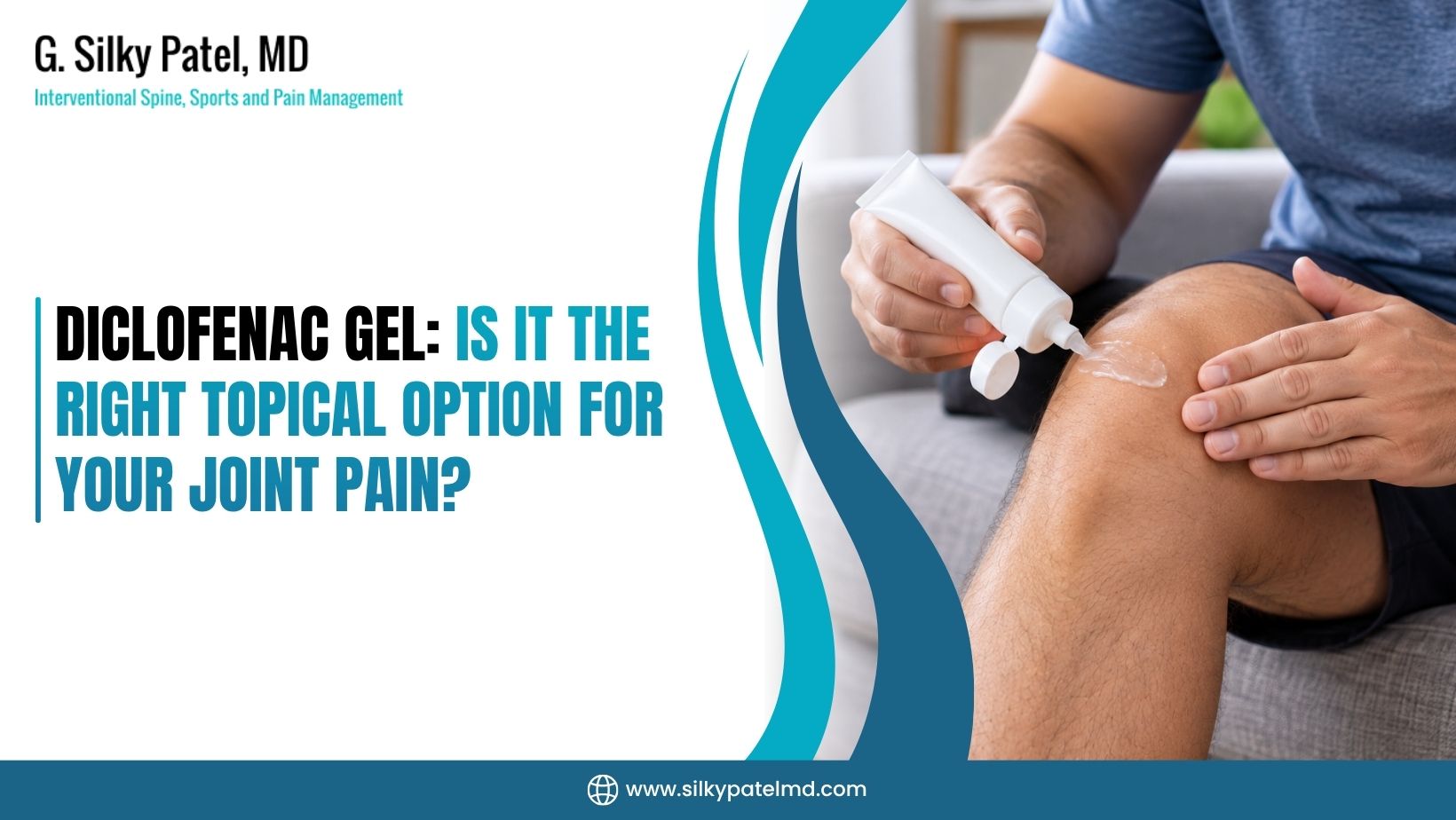
Apply the recommended measured amount to clean, dry skin over the affected joint and gently spread it as directed. Avoid applying it to cuts, rashes, infections, burns, or other damaged skin.
Wash your hands after application unless your hands are the treated area; if you are treating your hands, follow the product directions about when and how to wash them.
Many 1% diclofenac gel instructions use a smaller measured amount for upper-extremity joints and a larger amount for lower-extremity joints, with maximum daily amounts for an individual joint and for all treated joints combined.
Do not estimate by pouring freely. Use the dosing card or measuring method supplied with the product when provided.
What to Avoid After Applying It
After applying diclofenac gel, do not place a heating pad over the treated area, wrap the area tightly, or cover it with an airtight dressing unless Dr. Patel specifically instructs you to do so.
Avoid bathing or showering immediately if the product directions recommend waiting, and allow the gel to dry before covering the area with clothing.
Keep the gel away from the eyes, mouth, and other mucous membranes. Do not apply it at the same time as another topical product to the same area unless a qualified clinician has advised you to do so.
Store it safely away from children and pets, and wash hands after handling the tube.
Keep a Complete Medication List
Before starting diclofenac gel, include it on the medication list you share with Dr. Patel and the pharmacist. Mention oral ibuprofen, naproxen, aspirin, blood thinners, corticosteroids, blood-pressure medicines, and any medication that has affected your kidneys or stomach in the past.
A prescription pain cream containing diclofenac or another active ingredient may have different instructions from an over-the-counter product. Do not assume that a prescription formulation can be used like a store-bought gel, and do not transfer someone else’s medication to your own painful joint.
Side Effects, Safety Concerns, and When to Seek Care
Diclofenac gel can cause local skin reactions such as dryness, redness, itching, burning, or rash. Serious problems are less common but remain possible. Stop using the product and seek guidance if a skin reaction becomes significant, spreads, blisters, or does not improve.
Because diclofenac is an NSAID, important risks can also involve the digestive system, kidneys, heart, blood vessels, or allergic response. These risks are generally lower with appropriate topical use than with oral NSAIDs, but they are not eliminated.
People Who Should Ask Before Using It
Discuss diclofenac gel with Dr. Patel or a pharmacist before use if you have had an allergic or asthma reaction to aspirin or another NSAID.
Also ask first if you have a history of stomach ulcers or bleeding, kidney disease, heart failure, a recent heart attack, uncontrolled high blood pressure, or significant cardiovascular disease.
Tell Dr. Patel if you take anticoagulants or antiplatelet medicines, have a bleeding disorder, or are scheduled for surgery. Pregnancy and breastfeeding also require individualized guidance. NSAIDs may carry pregnancy-related risks, particularly later in pregnancy, so do not begin diclofenac without discussing it with the appropriate clinician.
Older adults and people with several chronic conditions may need a more careful medication review even if the product is available without a prescription. The same is true when pain is being treated with multiple products that contain an NSAID.
Warning Symptoms That Need Prompt Attention
Seek urgent medical help for trouble breathing, swelling of the face or throat, fainting, chest pain, sudden weakness, black or bloody stools, vomiting blood, or a severe blistering or peeling rash. These symptoms are uncommon but should not be ignored.
If you use diclofenac gel, contact a qualified clinician promptly for new swelling of the legs, markedly reduced urination, unusual bruising, severe stomach pain, or a significant increase in blood pressure. These symptoms do not prove that diclofenac is the cause, but they require assessment.
When Joint Pain Needs an Evaluation
Make an appointment with Dr. Patel when pain lasts longer than expected, interferes with sleep or daily activities, keeps returning, or is gradually worsening.
An evaluation is especially important if you have morning stiffness lasting a long time, repeated swelling, weakness, numbness, joint instability, or pain that extends beyond the joint.
At Dr. Silky Patel’s Houston pain medicine practice, the discussion can focus on the location and pattern of pain, prior treatments, medications, physical findings, and whether additional testing or a different treatment plan is appropriate.
If diclofenac gel is part of care, it should fit the diagnosis rather than substitute for one.
A Note from Dr. Silky Patel
Diclofenac gel can be a reasonable topical option for certain localized joint pain, particularly when the symptoms are consistent with arthritis and the medication fits your health history. It is not a universal answer, and careful application, medication review, and attention to warning symptoms matter.
If your joint pain is persistent, worsening, limiting movement, or not clearly explained, I encourage you to seek an evaluation rather than continuing to self-treat indefinitely.
At Dr. Silky Patel, we can discuss whether diclofenac gel belongs in your plan and what other pain-management options may be appropriate based on your symptoms and diagnosis.