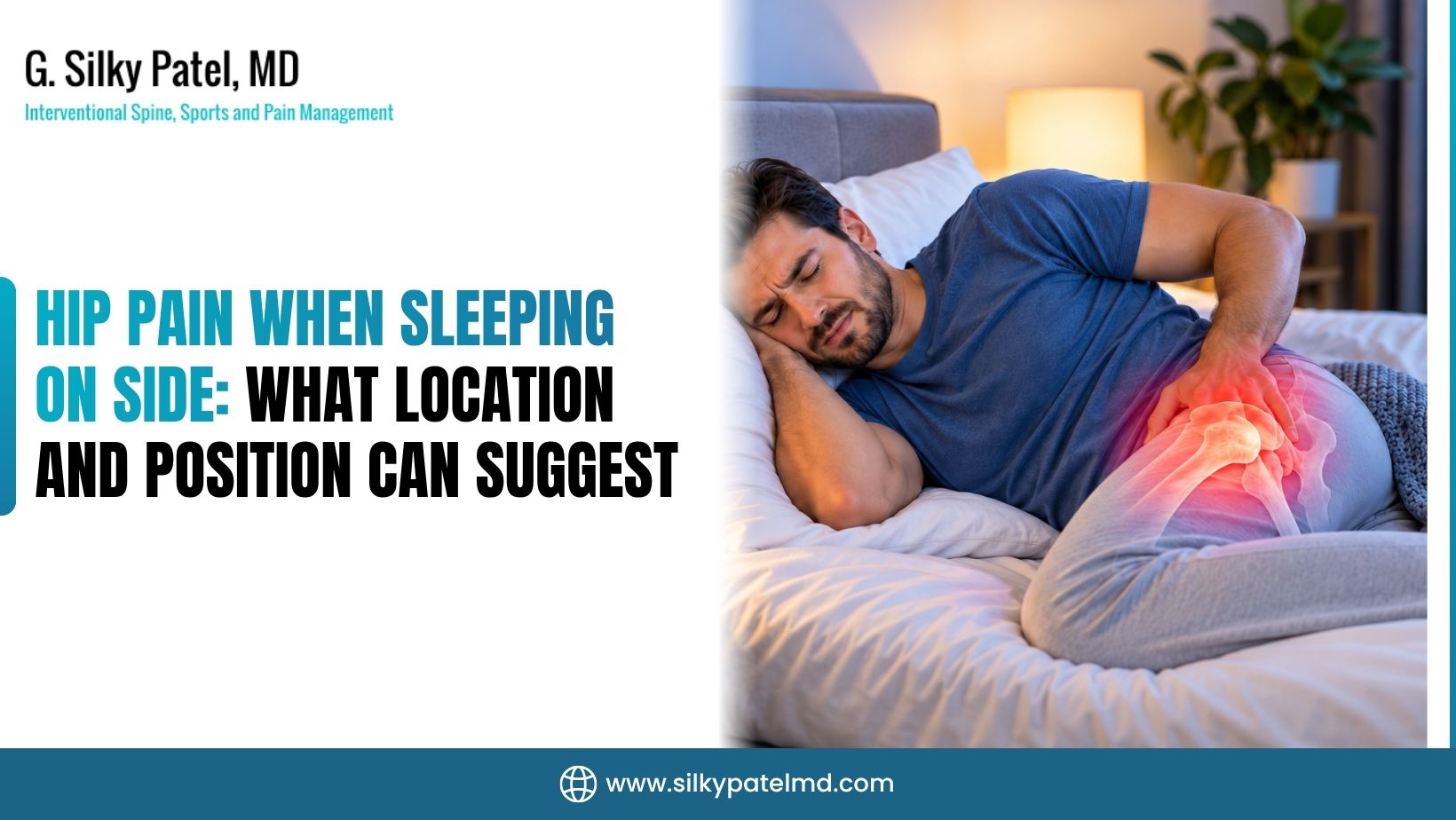
For people with hip pain when sleeping on side, it can be difficult to fall asleep, stay asleep, or turn comfortably in bed.
The location of the pain—on the outer hip, in the groin, or deeper in the joint—can provide useful information to share with Dr. Silky Patel, but it cannot establish a diagnosis by itself.
Nighttime pain matters because your sleep position may repeatedly place pressure on sensitive tissues. This guide explains what different pain locations and patterns may suggest, how to adjust your position and pillow support, which symptoms deserve prompt assessment, and what to discuss when seeking hip pain treatment near you.
Hip Pain When Sleeping on Side: Why Location Matters
The first useful detail is not simply that your hip hurts. It is where the pain begins, where it travels, and what activity or position brings it on.
Hip discomfort can be felt around the side of the pelvis, toward the front of the hip and groin, in the buttock, or farther down the thigh. These patterns can overlap, so location is a clue rather than a conclusion.
Outer Hip Pain and Pressure Sensitivity
When discussing hip pain when sleeping on side, outer hip pain is often felt over the bony area on the side of the hip.
Lying directly on that side can compress the tissues between the skin and the underlying bone. If the area is already sensitive, even the normal pressure of a mattress may make symptoms more noticeable at night.
To assess hip pain when sleeping on side, some people describe this discomfort as aching, burning, tenderness, or pain when the outer hip is touched. It may also become more apparent after walking, climbing stairs, standing for a long time, or lying on the affected side.
These features can occur with irritation in the soft tissues around the hip, but they do not prove hip bursitis. Similar symptoms may have other causes.
A practical observation is whether the pain is mainly produced by direct contact and pressure. If turning onto the other side reduces the discomfort fairly quickly, pressure sensitivity may be part of the pattern. That information is worth sharing with Dr. Patel during an evaluation.
Groin Pain May Feel Different
For concerns about hip pain when sleeping on side, pain in the groin or front of the hip may feel deeper than pain on the outside of the hip.
It can be noticed when getting out of a car, putting on socks, climbing stairs, pivoting, or bringing the knee toward the chest. Some people describe a catching, stiffness, or deep ache rather than tenderness at the skin or muscle surface.
A deeper sensation does not automatically mean a specific joint condition. Hip, pelvic, lower-back, and nearby soft-tissue problems can sometimes produce pain in similar areas.
The most useful next step is to describe the movement that triggers it, whether the pain is constant or intermittent, and whether it affects walking or range of motion.
Buttock or Thigh Symptoms Add More Context
To better understand hip pain when sleeping on side, pain in the buttock may be related to structures around the hip or may overlap with discomfort from the lower back or pelvis.
Pain that travels down the thigh, includes tingling or numbness, or changes with back position deserves a broader assessment rather than assuming the hip is the only source.
To better understand hip pain when sleeping on side, note the exact starting point of the pain, the direction it travels, and whether coughing, bending, walking, or lying down changes it.
A simple description such as “a deep ache in the groin when I rotate my leg” is more useful than only saying “my hip hurts.”

Our personalized treatment plans are designed to help you feel better and live better.
What Your Sleep Position May Be Telling You
Sleep position does not identify the cause of hip pain, but it can reveal which mechanical stresses aggravate your symptoms. The goal is not to force yourself into one “perfect” position.
It is to reduce prolonged pressure, avoid twisting, and find a position that allows your muscles and joints to remain as relaxed as possible.
Lying on the Painful Side
When tracking hip pain when sleeping on side, directly lying on the painful side places body weight through the outer hip.
A mattress that is very firm may increase pressure at the contact point, while a mattress that allows the pelvis to sink unevenly may create twisting through the hips and lower back. Neither mattress type is automatically right or wrong for everyone.
If you normally sleep on the affected side, try changing position for several nights rather than judging the adjustment after one attempt.
A pillow between the knees can help keep the upper leg from dropping forward and rotating the pelvis. Some people also benefit from a pillow that supports the entire leg rather than only the knee.
Lying on the Opposite Side
If you notice hip pain when sleeping on side, side-sleeping on the less painful side may reduce direct pressure on the sensitive hip. However, the upper leg can fall across the body and rotate the pelvis if it is not supported.
Place a firm, comfortable pillow between the thighs or knees, and consider extending the support toward the ankles if the lower leg feels pulled.
If hip pain when sleeping on side shifts to the opposite hip, the issue may be duration and alignment rather than the side itself. Changing positions periodically can be more practical than trying to stay in one posture all night.
Sleeping on Your Back
Back-sleeping may remove direct pressure from both outer hips. A pillow under the knees can reduce the tendency to arch the lower back and may make the position easier to maintain. If a pillow under the knees increases groin discomfort or feels restrictive, use less height or remove it.
When discussing hip pain when sleeping on side, do not treat these adjustments as a test that confirms or rules out a condition. A position may feel better because it reduces pressure even when the underlying reason for the pain remains unclear.
A Simple Position Experiment
If you’re managing hip pain when sleeping on side, make one change at a time for three to five nights. For example, keep your usual mattress and add a pillow between your knees.
Then record whether you fell asleep more easily, woke less often, or felt more stiff in the morning. Next, you might try back-sleeping with support under the knees.
This approach is more informative than changing the mattress, pillows, exercise routine, and medications all at once. It also gives Dr. Patel a clearer account of what affects your symptoms. Stop any adjustment that causes new numbness, weakness, severe pain, or worsening symptoms.
Our personalized treatment plans are designed to help you feel better and live better.
How to Relieve Hip Pain From Sleeping on Side
When tracking hip pain when sleeping on side, the most helpful nighttime strategy is usually a combination of pressure reduction, comfortable alignment, and attention to what happens during the day. A sleep adjustment may reduce irritation, but persistent or recurring pain still deserves an appropriate evaluation.
Use Pillow Support for Alignment
When tracking hip pain when sleeping on side, pillow support works best when it prevents the top leg from pulling the pelvis forward. When side-sleeping, place a pillow between the knees and allow the hips to remain stacked rather than letting the upper knee fall toward the mattress.
If your waist is unsupported and your spine bends toward the mattress, a small pillow under the side of the waist may help, but comfort should guide the adjustment.
When sleeping on your back, try support under the knees. If you move between positions, use a pillow that can be repositioned without requiring a major change in your routine. Excessively thick or stiff pillows may create a new pressure point, so more support is not always better.
Reduce Pressure Without Losing Sleep Quality
For people with hip pain when sleeping on side, a mattress topper may change how pressure is distributed, but it is not a guaranteed solution and should not be treated as treatment for the cause of hip pain.
Before purchasing new bedding, test whether a folded blanket or different pillow arrangement changes symptoms. This low-cost trial may help you decide whether pressure is a major contributor.
Avoid sleeping with the painful hip pressed against a hard surface or with the upper leg unsupported. If you use a recliner or couch to sleep because bed positioning is too painful, mention that during an evaluation. Needing an unusual sleeping arrangement can be clinically relevant.
Consider the Daytime Pattern
With hip pain when sleeping on side, nighttime symptoms may be influenced by what happened earlier.
A sudden pain increase in walking, hills, stairs, side-lying exercise, or prolonged standing may leave the tissues around the hip more sensitive by bedtime. The opposite can also occur: long periods of sitting may increase stiffness when you first move.
With hip pain when sleeping on side, rather than stopping all activity, reduce the specific activity that clearly increases pain and return gradually as tolerated.
Avoid repeatedly testing the painful movement to see whether it still hurts. If ordinary activities such as walking, getting dressed, or using stairs are becoming more difficult, seek guidance instead of relying only on home adjustments.
Use Medicines Carefully
Over-the-counter pain medicines are not appropriate for everyone. Stomach ulcers, kidney disease, blood-thinning medicines, pregnancy, allergies, and other health factors can affect whether a medication is safe. Follow the product label and ask a qualified healthcare professional about individual risks rather than combining products casually.
As you assess hip pain when sleeping on side, heat or cold may provide temporary comfort for some people. Protect the skin, limit exposure, and stop if symptoms worsen. These measures can support comfort while you arrange evaluation, but they do not determine why the pain is occurring.

Connect with our team to discuss your concerns, learn about our treatments, and find out how to get started as a new patient.
When Should Hip Pain at Night Be Assessed?
When discussing hip pain when sleeping on side, occasional discomfort after an unusual activity may improve with rest and position changes.
Pain that repeatedly interrupts sleep, limits walking, or continues despite reasonable adjustments deserves a clinical discussion. The purpose of an evaluation is to connect the symptom pattern with an examination and, when appropriate, additional testing.
Patterns Worth Sharing With Dr. Patel
Bring specific information rather than trying to name the condition yourself. Useful details include:
- Whether the pain is on the outer hip, in the groin, in the buttock, or along the thigh
- Which side hurts and whether both sides are involved
- Whether direct pressure, walking, stairs, getting into a car, or rotating the leg changes symptoms
- How long the problem has been present and whether it is worsening, intermittent, or constant
- Whether there is stiffness, clicking, catching, numbness, weakness, fever, swelling, or a recent injury
If you’re managing hip pain when sleeping on side, a short symptom diary can help. Write down your bedtime position, how often you wake, your pain level when lying down, and how you feel when you first stand up. Also note recent changes in activity, footwear, exercise, or work demands.
Signs That Warrant Prompt Assessment
Seek prompt medical assessment for severe pain after a fall or other injury, inability to bear weight, a visibly deformed area, rapidly increasing swelling, fever, redness or warmth around the hip, or new weakness or loss of sensation.
Unexplained weight loss, a history of cancer, or pain that is severe and progressively worsening should also be discussed promptly.
To better understand hip pain when sleeping on side, emergency care may be appropriate when symptoms are severe, sudden, or associated with major injury or significant weakness. If you are uncertain how urgently to act, contact an appropriate healthcare service for guidance rather than waiting for a routine visit.
Why Self-Diagnosis Can Mislead
For concerns about hip pain when sleeping on side, the phrase “hip bursitis symptoms” is often used for outer hip pain, but several conditions can produce similar discomfort.
Likewise, deep groin pain is not enough to confirm a problem inside the hip joint. Pain can also be referred from nearby structures, including the lower back.
An evaluation should consider the full pattern: location, movement, strength, sensation, gait, tenderness, and the effect of different positions. Dr. Patel can use that information to discuss reasonable next steps without assuming that one symptom automatically points to one diagnosis.
What to Expect From Hip Pain Treatment Near You
When seeking care for hip pain when sleeping on side, compare more than the name of a procedure if you search for hip pain treatment near me or a hip pain doctor in Houston.
A useful evaluation should begin with your symptoms, goals, activity limitations, medical history, and examination findings. Treatment decisions should follow the working diagnosis and your individual circumstances.
Start With the Evaluation
As you assess hip pain when sleeping on side, at a consultation with Dr. Silky Patel, be prepared to explain what happens at night as well as during the day.
Mention whether you can sleep on your back, whether the painful side is tender to touch, and whether the pain changes when you stand, walk, or rotate your leg. Bring a current medication list and information about prior imaging or treatment if available.
Imaging is not automatically necessary for every episode of hip pain. Dr. Patel may determine whether imaging or another evaluation is useful based on the history and physical findings. The important question is not whether a scan can be ordered, but whether the result would change the care plan.
Conservative Options and Follow-Up
If you notice hip pain when sleeping on side, depending on the findings, care may include activity modification, movement guidance, targeted exercises, medication discussion, or follow-up to monitor the pattern. The right plan depends on whether symptoms are improving, stable, or interfering with everyday function.
A common mistake is to judge progress only by whether the pain disappeared the first night. More useful measures may include fewer awakenings, improved ability to lie on one side, easier walking, or less pain when getting dressed. Share both improvements and setbacks so the plan can be adjusted appropriately.
When Injections May Be Discussed
Hip injections for pain may be considered in selected situations, but an injection is not automatically appropriate simply because pain occurs at night. The target, purpose, potential risks, and expected limitations depend on the suspected pain source and the examination.
When assessing hip pain when sleeping on side, ask what structure an injection would target if Dr. Patel discusses one, what the procedure is intended to help with, what alternatives exist, and what follow-up will be needed.
Results vary, and an injection should be part of an individualized plan rather than a substitute for understanding the symptom pattern.
Choosing a Practical Next Step in Houston
For someone seeking a hip pain doctor in Houston because of hip pain when sleeping on side, the next step may be a consultation with Dr. Silky Patel if nighttime symptoms are persistent, disruptive, or difficult to interpret.
Bring your sleep-position observations and a concise symptom history. Those details can make the visit more focused and help you understand which options are reasonable to discuss.
A Note from Dr. Silky Patel
When hip pain wakes you at night, the most useful first step is to observe the pattern without trying to diagnose it yourself.
Note whether direct pressure, a particular sleep position, walking, stairs, or hip movement changes the discomfort. Small adjustments such as supporting the upper leg or reducing pressure may improve comfort, but ongoing or worsening symptoms deserve evaluation.
Hip pain when sleeping on side can arise from more than one source, and the location of pain is only one part of the assessment.
I encourage you to share the full pattern—including sleep disruption, daytime limitations, and any warning signs—so we can discuss an appropriate, individualized path forward.